

Should I still be Here?
Knowing When Jesus Is Moving You On

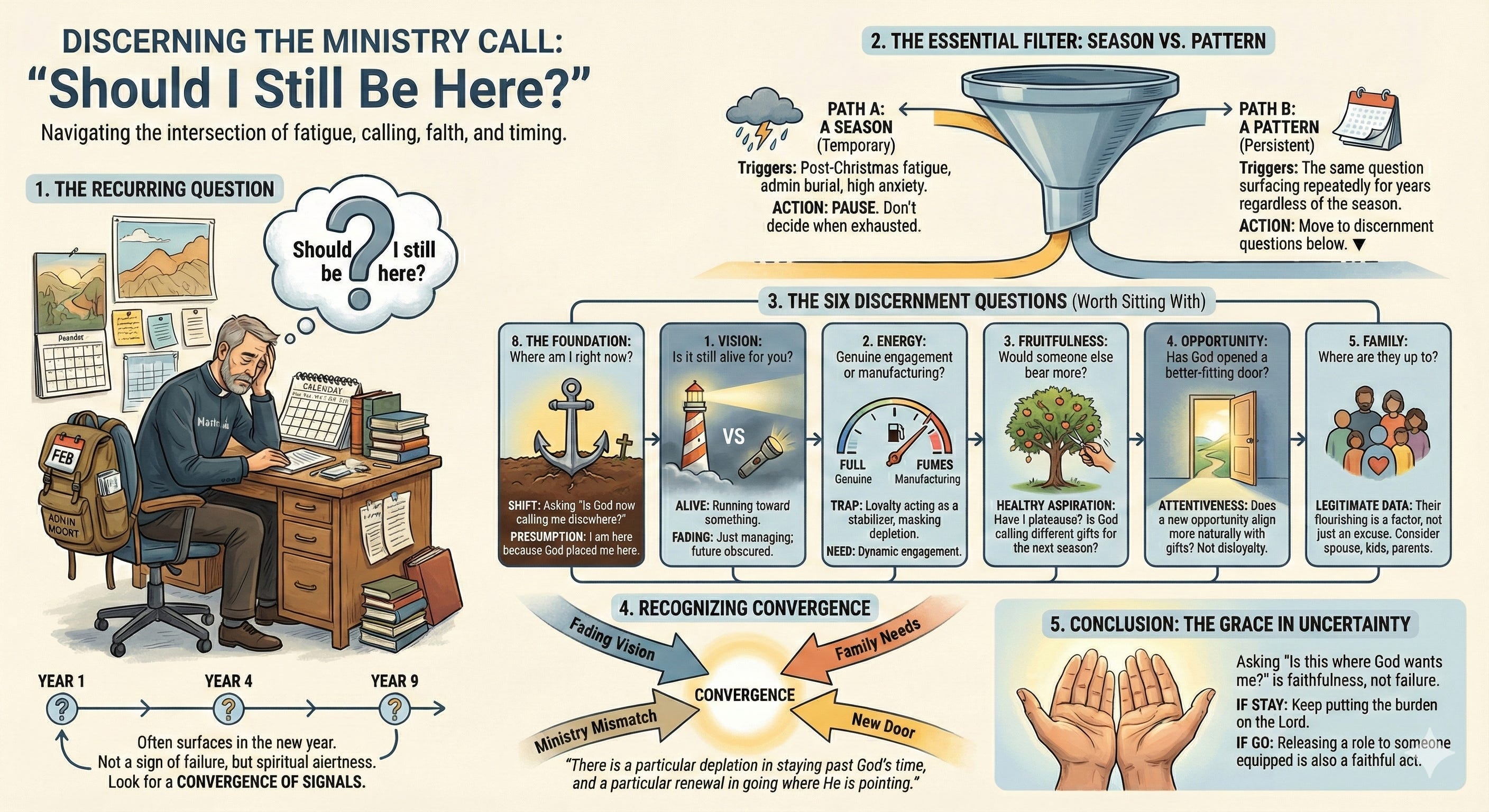
Mark had been the Pastor at the same church for nine years. He was good at it. People were growing. The congregation loved him. But almost every year, usually around February when the new year kicked into gear and the weight of it all settled back onto his shoulders, the question surfaced: Should I still be here?
He’d bring it to his supervisor. They’d talk it through. He’d feel settled. Six months later, it would return.
I’ve sat with ministry leaders like Mark more times than I can count. The question isn’t always a sign that something is wrong. Sometimes it’s the most honest, spiritually alert thing a ministry leader can ask. But it’s one of the hardest questions to discern well, because it lives at the intersection of fatigue, calling, ego, faith, and timing.
The ministry leaders who navigate this well aren’t the ones who find the one definitive sign. They’re the ones who pay attention to a convergence of signals. Multiple things, pressing in from different directions, all pointing the same way.
Distinguish the Question from the Season
The question “should I leave?” often emerges most loudly at the worst possible time to answer it. It surfaces in February when you’re buried under admin and haven’t had a proper break. It surfaces after a couple leaves the church and you feel it as a referendum on your leadership. It surfaces when anxiety is high and sleep is poor.
Before you start answering it, ask yourself: Is this a season, or is this a pattern?
A season is the exhausting start to the year. A pattern is the question that’s been there for years regardless of the season.
The Questions Worth Sitting With
There are numerous questions worth bringing to this discernment. Here are five or six I’ve found most consistently useful.
0. Where am I right now?
Before you interrogate your calling, your energy, or your future, there’s a more foundational question that too many ministry leaders skip: Where has God placed me? Where you currently are is not an accident. It is the sovereign decision of a God who places those he calls into the body where he wants them. As Paul puts it, he determines the times and places where we live. That includes your church, your community, your role.
The starting place for discernment about leaving is a sober recognition that you are where you are because God put you there. That reframes the question. You’re not asking “can I find a better fit?” You’re asking “is God now directing me somewhere else?” That requires genuine evidence rather than just restlessness. Unless there are clear points of convergence pointing elsewhere, the presumption should be: I am here because God wants me here.
1. Is the vision still alive for you?
Ministry requires a genuine sense that you can see something worth building. When that vision is present, even a hard season has a texture to it. You’re running toward something, even when you’re tired. When it’s gone, the hard seasons feel different. You’re just managing.
Not that ministry doesn’t involve seasons where vision is seen through a glass darkly, where everything looks blurry and the future feels obscured. That’s normal. But if you’ve lost hope altogether, if your vision for where God is taking things has become a hopeless mess, that’s a moment to cry out to God for fresh vision and fresh hope. Ask him to give you back what you can’t manufacture yourself. That prayer is worth staying with before you start asking whether it’s time to leave.
2. Is your personality still genuinely engaged, or are you manufacturing?
Some ministry leaders are, by nature, optimistic, relational, and energising. But those traits can mask a deeper depletion. When you’re manufacturing enthusiasm because your personality can produce it, you can go a long time before anyone, including yourself, notices that the tank is empty. The question isn’t just “do I still have energy?” It’s where is the energy coming from?
Sometimes ministry leaders are sustained by genuinely good things: loyalty to a congregation they love, a sense of responsibility for people in their care, a deep unwillingness to let anyone down. Those aren’t bad motivations. But loyalty and responsibility are stabilisers, not engines. Leadership needs something more dynamic: ongoing vision, genuine engagement, and a sense that God is in this with you now, not just that he called you here back then.
3. Would someone else bear more fruit in this role?
This is a difficult question to handle well. Comparing yourself to the most gifted people in the room will always leave you wanting, and that’s not useful discernment. But the question underneath it isn’t wrong. It’s worth asking honestly: Is God calling someone with a different set of gifts to do something here that I’m not able to do?
The healthy version of this question isn’t comparison, it’s aspiration. It asks: am I continuing to develop in this role, or have I plateaued in a way that’s more about comfort than conviction? If I don’t have a gift that I and others believe is critical for my role, then start by asking God for it. If it doesn’t come, perhaps the ministry role is for someone else.
4. Has God opened a door that looks like a better fit?
Sometimes the clearest signal isn’t a fading vision in your current role, it’s a new opportunity appearing that seems to align more naturally with your gifts, your energy, and your sense of calling. It’s worth holding with humility, because every ministry context has its version of the hard February. But when an opportunity emerges that seems to fit your God-given wiring more fully, that’s worth treating as a serious prompt. God does open doors. Noticing that one has opened isn’t disloyalty. It’s attentiveness.
5. Where is my family up to?
A ministry move affects not just you but the people closest to you, and that matters to God too. This isn’t a question only for those who are married with children. Singles carry family commitments too: ageing parents who may need increasing care and proximity, siblings navigating crises, community networks that have taken years to build and can’t simply be transplanted.
For those with a spouse and kids: can you really take your children out of school at this stage? Your spouse may have work and community relationships she genuinely loves. These aren’t ungodly prompts. They are genuine recognition of the impact a move will have on the people closest to you. Your family’s flourishing is a legitimate factor in the discernment, and it becomes more significant when your situation carries particular vulnerabilities: children with special needs, a spouse managing a medical condition, ageing parents who need you nearby. These aren’t excuses for staying put. They are real data points that a wise discernment process should weigh honestly.
When the Signals Converge
If you’re settled on where God has placed you, the vision is alive, your engagement is genuine, your family is in a good place, and no door has opened elsewhere, you’re probably where you’re supposed to be. Stay, and stop asking the question so loudly.
If the picture is more complicated, pay attention to where the weight is falling. A fading vision you’ve been unable to pray back to life. Energy that’s been manufactured for longer than you can remember. A growing sense that someone with different gifts could serve this community better. A family situation that a move would genuinely destabilise. Or conversely, a door that has opened that seems to fit your God-given wiring in ways your current role no longer does. When several of these are pointing in the same direction, that convergence is worth taking seriously.
Bring it to your supervisor, your spouse, your leaders, and God with real seriousness. And pay attention to how long you’ve been asking the question. A hard season is one thing. If the same prompting has surfaced every year for four years, that frequency is itself a data point worth sitting with.
What Convergence Looked Like for Me
When I finished up at St Matthew’s Botany, it wasn’t one thing. It was three main things converging. A genuine sense that the church needed someone with fresh vision and the God-given energy to pursue it. The increasing complexity of my Parkinson’s symptoms, particularly the anxiety and difficulty concentrating on a Sunday morning. And a growing hunch that God was calling me toward pastoral supervision, toward a broader vision for helping ministry workers across the wider body of Christ. Jesus’ red sheep. I felt a pull toward that work I couldn’t dismiss.
At the time, it was excruciating. Three good months of genuine grief, with tears most days, over walking away from people I loved. Away from a staff team I had deep connection with. Away from a church family who were genuinely dear to me.
And yet. The pastor who came after me, known as Bootsy, has been extraordinary. St Matt’s has doubled in size, reflecting the God-given gifts and vision he brought to that role. What I couldn’t produce, he could. That’s not a statement about failure. It’s a statement about the wisdom of the one who calls and places his servants.
And something else happened that I didn’t expect. When I stepped into the new season, something came alive in me that I had quietly assumed was gone. Fresh vision. Genuine energy. A sense of leading people somewhere that felt alive rather than manufactured. I had assumed the fog and flatness near the end at St Matt’s was simply what Parkinson’s would mean for the rest of my ministry. I had made a kind of peace with diminishment.
But the diminishment wasn’t only the Parkinson’s. Some of it was the mismatch between where I was and where God was calling me to be. The gifts hadn’t disappeared. They had been waiting for the right ground.
There is a particular kind of depletion that comes from staying somewhere past the time God has for you there, and a particular kind of renewal that comes when you finally go where he’s been pointing. I experienced both. It was confirmation. The slow, embodied kind.
One important thing to note
The discernment questions above assume a relatively stable ministry context, one where things are broadly functioning well even if the minister is tired or uncertain. But a significant number of ministry leaders come to the “should I leave?” question not from that place, but from the wreckage of a breakdown. Staff relationships fractured beyond repair. Burnout that has hollowed out more than just energy. A conflict that has left lasting damage to trust. When that is the terrain, the discernment questions look quite different, because the signals are harder to read through the noise of pain, shame, and survival. Whether to leave in the aftermath of breakdown is a question that deserves its own careful treatment, and I hope to return to it in a future article.
The Grace in the Uncertainty
Asking “is this still where God wants me?” is not a sign of failure. It can be a form of faithfulness, not faithlessness. What tends to go wrong is when it becomes anxious rumination rather than prayerful discernment, driven by fear of being seen as the leader who couldn’t make it work.
As long as the answer is yes, stay, and keep putting the burden back on the Lord. And if the convergence is pointing elsewhere, that’s not failure either. Sometimes, the most faithful thing you can do is release a role to someone who has what the ministry needs for its next season.